




How does the external magnetic field affect a cylindrical magnet?
 Aug 11, 2025|
 Hey there! As a supplier of Magnet Cylindrical products, I've spent a ton of time diving into the fascinating world of magnets. One question that often pops up is how an external magnetic field affects a cylindrical magnet. So, let's dig into this topic and break it down.
First off, let's understand what a cylindrical magnet is. You can check out our Cylindrical Permanent Magnet for a better idea. These magnets are, well, shaped like cylinders. They come in various sizes and strengths, and they're used in all sorts of applications, from electronics to industrial machinery.
Now, when we talk about an external magnetic field, we're referring to a magnetic field that's created outside of the cylindrical magnet itself. This external field can come from another magnet, an electromagnet, or even the Earth's magnetic field in some cases.
So, how does this external magnetic field affect our cylindrical magnet? Well, one of the most obvious effects is the force it exerts on the magnet. According to the laws of magnetism, like poles repel each other, and opposite poles attract. So, if the external magnetic field has a pole that's the same as one of the poles of our cylindrical magnet, there'll be a repulsive force. On the other hand, if the poles are opposite, there'll be an attractive force.
Let's say we have a cylindrical magnet with its north pole facing an external magnetic field's north pole. The two north poles will push against each other, trying to move the cylindrical magnet away. This can be really important in applications where you need to control the position or movement of the magnet. For example, in some types of sensors, the interaction between the external magnetic field and the cylindrical magnet can be used to detect changes in position or movement.
Another effect of the external magnetic field on the cylindrical magnet is the potential to change its magnetization. The magnetization of a magnet refers to the direction and strength of its magnetic field. When an external magnetic field is applied, it can either align or misalign the magnetic domains within the cylindrical magnet.
Magnetic domains are tiny regions within the magnet where the magnetic moments of the atoms are aligned in the same direction. In a well - magnetized cylindrical magnet, these domains are mostly aligned in one direction, giving the magnet its overall magnetic field. But when an external magnetic field is introduced, it can try to re - align these domains.
If the external magnetic field is strong enough and in a different direction from the magnet's original magnetization, it can start to change the alignment of the magnetic domains. This can lead to a decrease in the magnet's overall magnetization, or even a complete reversal of its polarity. This is something we need to be really careful about in applications where the stability of the magnet's magnetization is crucial.
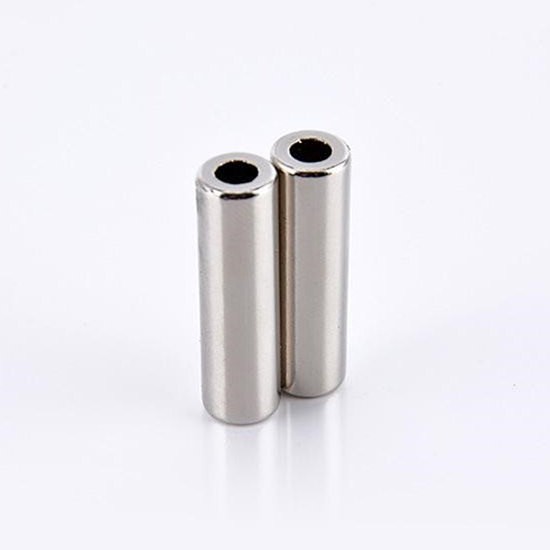

Let's take a look at Hollow Cylinder Magnets. These are a special type of cylindrical magnet with a hole in the middle. The effect of an external magnetic field on them can be a bit different compared to solid cylindrical magnets. The hollow space can affect how the magnetic field lines interact with the magnet. The magnetic field lines can pass through the hollow part, which can change the distribution of the magnetic forces within the magnet.
In some cases, the hollow space can make the magnet more sensitive to the external magnetic field. This is because the magnetic field lines can more easily penetrate the magnet and interact with the magnetic domains. On the other hand, it can also make the magnet more complex to analyze in terms of its magnetic behavior.
Now, let's talk about Cylinder Shape Magnet in general. The shape of the cylinder can also play a role in how it responds to an external magnetic field. The length and diameter of the cylinder can affect the distribution of the magnetic field within the magnet and how it interacts with the external field.
A long and thin cylindrical magnet will have a different magnetic field distribution compared to a short and thick one. The long and thin magnet will have a more concentrated magnetic field at its poles, while the short and thick magnet will have a more spread - out field. This means that they'll respond differently to an external magnetic field. For example, a long and thin magnet might be more likely to rotate in an external magnetic field compared to a short and thick one.
In industrial applications, understanding how the external magnetic field affects the cylindrical magnet is crucial for designing efficient and reliable systems. For instance, in electric motors, the interaction between the external magnetic field (created by the stator) and the cylindrical magnets (in the rotor) is what makes the motor work. If the cylindrical magnets aren't properly designed to handle the external magnetic field, the motor might not operate efficiently or could even fail.
In addition, in magnetic separation processes, the external magnetic field is used to separate magnetic materials from non - magnetic ones. The cylindrical magnets need to be carefully selected and placed so that they can effectively interact with the external magnetic field and attract the magnetic particles.
As a supplier of Magnet Cylindrical products, we're constantly working on improving our understanding of these magnetic interactions. We test our magnets under different external magnetic field conditions to ensure that they meet the requirements of our customers. Whether it's for a small electronic device or a large industrial machine, we want to make sure that our cylindrical magnets perform at their best.
If you're in the market for high - quality cylindrical magnets and want to learn more about how they'll perform in your specific external magnetic field environment, we'd love to have a chat with you. We can provide you with detailed information about our products and help you choose the right cylindrical magnet for your application. Contact us for a discussion and let's work together to find the perfect magnetic solution for you.
References
- Purcell, E. M., & Morin, D. J. (2013). Electricity and Magnetism. Cambridge University Press.
- Griffiths, D. J. (2017). Introduction to Electrodynamics. Cambridge University Press.