




How does the magnetic field of a cylindrical magnet interact with a diamagnetic material?
 Aug 25, 2025|
 In the fascinating realm of magnetism, understanding how the magnetic field of a cylindrical magnet interacts with a diamagnetic material is not only a subject of scientific curiosity but also holds practical implications for various industries. As a supplier of high - quality Magnet Cylindrical, I've had the privilege of delving deep into these interactions and their real - world applications.
Understanding the Basics: Cylindrical Magnets and Diamagnetic Materials
Let's start by getting a clear understanding of our two main players. Cylindrical magnets are a common type of permanent magnet with a circular cross - section and a uniform magnetic field distribution. They are widely used in different applications such as motors, sensors, and magnetic separators due to their reliable and predictable magnetic properties. These magnets can be made from various materials, including neodymium, ferrite, and samarium - cobalt, each offering different levels of magnetic strength and temperature resistance.
On the other hand, diamagnetic materials are substances that exhibit a weak, negative susceptibility to magnetic fields. When placed in an external magnetic field, diamagnetic materials generate an induced magnetic field in the opposite direction of the applied field. This property causes them to be repelled by magnetic fields, although the repulsive force is generally very weak compared to the forces exerted on ferromagnetic or paramagnetic materials. Common examples of diamagnetic materials include copper, bismuth, and water.
The Magnetic Field of a Cylindrical Magnet
The magnetic field of a cylindrical magnet can be visualized using magnetic field lines. These lines emerge from the north pole of the magnet, loop around outside the magnet, and re - enter at the south pole. Inside the magnet, the field lines run from the south pole to the north pole, forming a continuous loop.
The strength of the magnetic field varies depending on the distance from the magnet. Near the poles of the cylindrical magnet, the magnetic field is the strongest, and it weakens as you move further away from the magnet. The magnetic field strength also depends on the magnetization of the magnet material and the dimensions of the cylinder. For a given material, a larger and more strongly magnetized cylindrical magnet will produce a stronger magnetic field.
Interaction with Diamagnetic Materials
When a diamagnetic material is brought into the magnetic field of a cylindrical magnet, the induced magnetic field in the diamagnetic material opposes the external magnetic field of the magnet. This opposition results in a repulsive force between the magnet and the diamagnetic material.
The magnitude of the repulsive force is proportional to the strength of the external magnetic field and the magnetic susceptibility of the diamagnetic material. Since diamagnetic susceptibilities are typically very small (on the order of 10⁻⁵ to 10⁻⁶), the repulsive force is usually quite weak. For example, if you were to place a small piece of copper near a cylindrical magnet, you would observe only a very slight repulsion.
However, in some cases, with strong enough magnetic fields and properly designed setups, the interaction between a cylindrical magnet and a diamagnetic material can be used for practical purposes. One such application is magnetic levitation. By carefully controlling the magnetic field of a cylindrical magnet and the properties of the diamagnetic material, it is possible to achieve stable levitation of the diamagnetic object. This principle has been used in experimental setups to levitate small objects such as graphite flakes or even living organisms like frogs.
Factors Affecting the Interaction
Several factors can influence the interaction between the magnetic field of a cylindrical magnet and a diamagnetic material.
- Magnetic Field Strength: As mentioned earlier, the stronger the magnetic field of the cylindrical magnet, the greater the repulsive force on the diamagnetic material. Using a high - strength Hollow Cylinder Magnets or Small Cylindrical Magnets made from neodymium can significantly enhance the interaction compared to a weaker ferrite magnet.
- Distance: The repulsive force follows an inverse - square law with respect to the distance between the magnet and the diamagnetic material. As the distance increases, the force decreases rapidly.
- Shape and Size of the Magnet: The shape and size of the cylindrical magnet can affect the distribution of the magnetic field. A longer or wider cylinder may have a different magnetic field pattern compared to a shorter or narrower one, which can in turn influence the interaction with the diamagnetic material.
- Properties of the Diamagnetic Material: Different diamagnetic materials have different magnetic susceptibilities. Materials with higher susceptibilities will experience a stronger repulsive force when placed in the magnetic field of a cylindrical magnet.
Practical Applications
The interaction between cylindrical magnets and diamagnetic materials has several practical applications across different industries.
- Magnetic Separation: In some industrial processes, it is necessary to separate diamagnetic materials from other substances. By using a strong cylindrical magnet, diamagnetic particles can be repelled and separated from a mixture. This technique is used in the mining industry to separate valuable minerals from diamagnetic gangue materials.
- Sensors: The weak interaction between a cylindrical magnet and a diamagnetic material can be used to design sensitive sensors. Changes in the position or properties of the diamagnetic material can cause small changes in the magnetic field, which can be detected and used to measure physical quantities such as displacement, pressure, or temperature.
- Magnetic Levitation Technologies: As mentioned earlier, magnetic levitation using the interaction between cylindrical magnets and diamagnetic materials has potential applications in transportation and high - precision manufacturing. Although the repulsive forces are weak, with advanced engineering and control systems, it is possible to achieve stable levitation for various purposes.
Conclusion
The interaction between the magnetic field of a cylindrical magnet and a diamagnetic material is a complex yet fascinating phenomenon. Understanding the principles behind this interaction can lead to innovative applications in multiple fields, from industrial processes to advanced technologies.

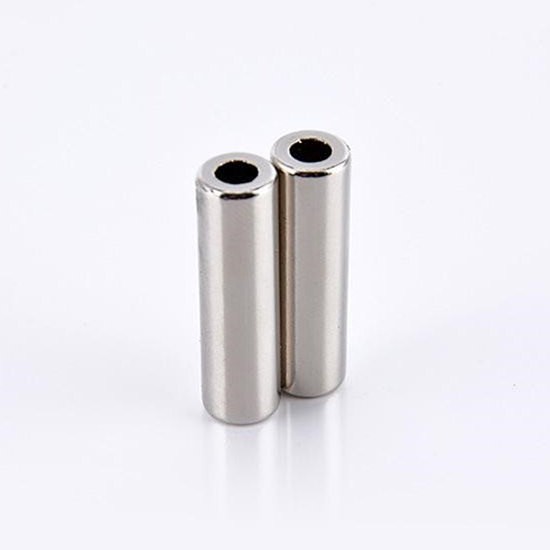
As a supplier of Magnet Cylindrical, Hollow Cylinder Magnets, and Small Cylindrical Magnets, I am always excited to see how these magnets can be used to explore new frontiers in magnetism. Whether you are a researcher looking to conduct experiments on magnetic interactions or an industry professional seeking high - quality magnets for your applications, I invite you to contact me for further discussions and to explore potential procurement opportunities.
References
- Griffiths, D. J. (1999). Introduction to Electrodynamics. Prentice Hall.
- Kittel, C. (2004). Introduction to Solid State Physics. Wiley.
- Purcell, E. M., & Morin, D. J. (2013). Electricity and Magnetism. Cambridge University Press.