




How to calculate the magnetic force of a cylindrical magnet?
 Dec 22, 2025|
 Calculating the magnetic force of a cylindrical magnet might seem like a daunting task, but it's actually quite doable with the right approach. As a supplier of [Cylindrical Magnets], I've had my fair share of dealing with this. Whether you're an engineer working on a new project or a hobbyist looking to understand more about magnets, this blog post will guide you through the process.
Understanding the Basics of Cylindrical Magnets
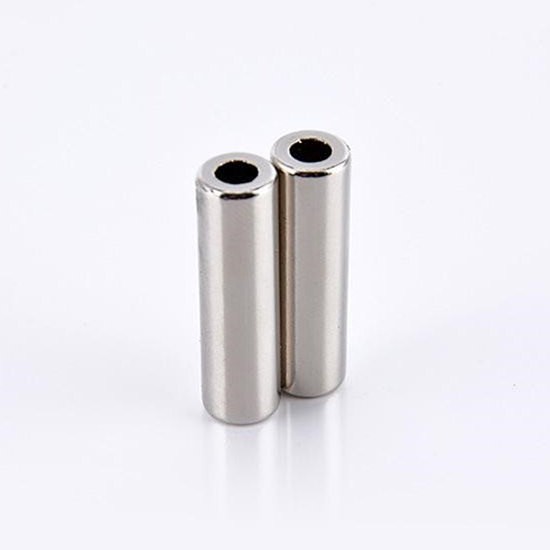
Before we dive into the calculations, let's quickly go over what cylindrical magnets are. Cylindrical magnets are, well, shaped like cylinders. They're one of the most common types of magnets out there and are used in a wide range of applications, from motors and generators to magnetic separators and even in some consumer products.
We offer a variety of cylindrical magnets, including Hollow Cylinder Magnets, Magnet Cylindrical, and Cylindrical Permanent Magnet. Each type has its own unique properties and uses, but the basic principles of calculating their magnetic force are the same.
Factors Affecting the Magnetic Force of Cylindrical Magnets
The magnetic force of a cylindrical magnet depends on several factors:
- Magnetic Field Strength (B): This is a measure of the strength of the magnetic field produced by the magnet. It's usually measured in teslas (T) or gauss (G). The higher the magnetic field strength, the stronger the magnetic force.
- Area of the Magnet (A): The larger the surface area of the magnet that comes into contact with another magnetic object, the greater the magnetic force. For a cylindrical magnet, the area is calculated using the formula for the surface area of a cylinder.
- Distance between Magnets (d): The magnetic force decreases as the distance between two magnets increases. This relationship follows the inverse square law, which means that if you double the distance between two magnets, the magnetic force decreases by a factor of four.
- Permeability of the Medium (μ): The magnetic force also depends on the material between the magnets. Different materials have different permeabilities, which affect how the magnetic field passes through them.
The Formula for Calculating Magnetic Force
The magnetic force between two cylindrical magnets can be calculated using the following formula:
[ F = \frac{\mu_0 \cdot B_1 \cdot B_2 \cdot A}{2 \cdot \mu_r \cdot d^2} ]
Where:

- ( F ) is the magnetic force (in newtons, N)
- ( \mu_0 ) is the permeability of free space (( 4\pi \times 10^{-7} , \text{T} \cdot \text{m} / \text{A} ))
- ( B_1 ) and ( B_2 ) are the magnetic field strengths of the two magnets (in teslas, T)
- ( A ) is the area of the magnet that comes into contact with the other magnet (in square meters, ( \text{m}^2 ))
- ( \mu_r ) is the relative permeability of the medium between the magnets (dimensionless)
- ( d ) is the distance between the two magnets (in meters, m)
Step-by-Step Guide to Calculating the Magnetic Force
Let's break down the calculation process into simple steps:
Step 1: Determine the Magnetic Field Strength
The magnetic field strength of a magnet is usually provided by the manufacturer. If you don't have this information, you can use a gaussmeter to measure it. Make sure to measure the magnetic field strength at the surface of the magnet, as this is where the magnetic force is strongest.
Step 2: Calculate the Area of the Magnet
For a cylindrical magnet, the area that comes into contact with another magnet is usually the end face of the cylinder. The formula for the area of a circle is ( A = \pi \cdot r^2 ), where ( r ) is the radius of the cylinder.
Step 3: Measure the Distance between the Magnets
Use a ruler or a caliper to measure the distance between the two magnets. Make sure to measure the shortest distance between the surfaces of the magnets.
Step 4: Determine the Relative Permeability of the Medium
If the magnets are in air or a vacuum, the relative permeability (( \mu_r )) is approximately 1. If they're in a different medium, you'll need to look up the relative permeability of that medium.
Step 5: Plug the Values into the Formula
Once you have all the necessary values, plug them into the formula to calculate the magnetic force. Make sure to use the correct units (teslas for magnetic field strength, square meters for area, and meters for distance).
Example Calculation
Let's say we have two cylindrical neodymium magnets with the following properties:
- Magnetic field strength (( B_1 = B_2 )): 1.2 T
- Radius of the magnets (( r )): 0.05 m
- Distance between the magnets (( d )): 0.01 m
- Medium: Air (( \mu_r = 1 ))
First, calculate the area of the magnet:
[ A = \pi \cdot r^2 = \pi \cdot (0.05 , \text{m})^2 = 0.00785 , \text{m}^2 ]
Then, plug the values into the formula:
[ F = \frac{\mu_0 \cdot B_1 \cdot B_2 \cdot A}{2 \cdot \mu_r \cdot d^2} ]
[ F = \frac{(4\pi \times 10^{-7} , \text{T} \cdot \text{m} / \text{A}) \cdot (1.2 , \text{T}) \cdot (1.2 , \text{T}) \cdot (0.00785 , \text{m}^2)}{2 \cdot 1 \cdot (0.01 , \text{m})^2} ]
[ F \approx 0.178 , \text{N} ]
So, the magnetic force between the two magnets is approximately 0.178 newtons.
Practical Considerations
While the formula gives you a good estimate of the magnetic force, there are some practical considerations to keep in mind:
- Magnet Shape and Orientation: The shape and orientation of the magnets can affect the magnetic force. For example, if the magnets are not perfectly aligned, the magnetic force may be weaker.
- Magnetic Saturation: If the magnets are exposed to a very strong magnetic field, they may become saturated, which means that their magnetic field strength no longer increases.
- Temperature: The magnetic properties of magnets can change with temperature. Some magnets, like neodymium magnets, can lose their magnetization at high temperatures.
Conclusion
Calculating the magnetic force of a cylindrical magnet is a useful skill that can help you in a variety of applications. By understanding the factors that affect the magnetic force and using the appropriate formula, you can make accurate calculations and design better magnetic systems.
If you're in the market for high-quality cylindrical magnets, we're here to help. We offer a wide range of Cylindrical Magnets to meet your specific needs. Whether you're working on a small project or a large-scale industrial application, we have the right magnet for you. Contact us to discuss your requirements and get a quote. We're always happy to help you find the perfect solution for your magnetic needs.
References
- "Introduction to Magnetism and Magnetic Materials" by David Jiles
- "Magnetic Materials: Fundamentals and Applications" by E. C. Stoner and E. P. Wohlfarth